
THE STUDENT AND THE TEN PARAMETERS (TO SAY NOTHING OF THE BLENDER)
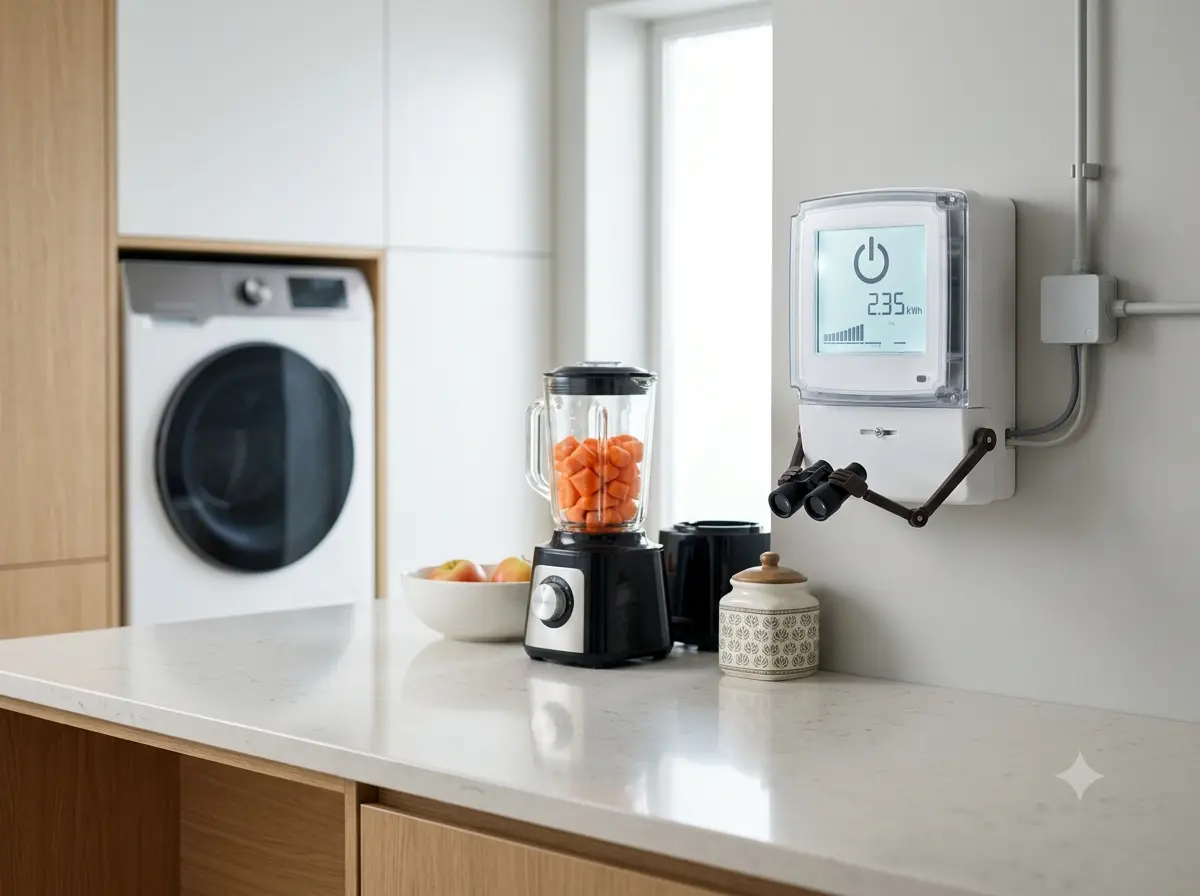
A few years ago a student called me looking for a BSc thesis topic. We were knee-deep in IoT sensors for industry at the time, and one problem followed us to every customer site: integrated monitoring on real production machines is expensive, and painfully so on the older ones, with no documentation, no exposed interface, no protocol anyone still remembers, and a vendor who either does not exist anymore or quotes you a number ending in "per machine, per year."
So we kept asking the obvious question. If we cannot get inside the machine cheaply, what can we learn from outside it, using small cheap sensors that we stick on or near the thing and walk away from? That became the thesis.
The list of what you can measure from outside turns out to be shorter than people imagine, but rich enough to be interesting: noise, vibration, surface temperature, magnetic field around the cables, air flow, and how much electricity the machine is pulling when you sample it fast enough to see it breathe. Around ten signals in total, each one shouting in its own little language about what the machine was doing.
The first conclusion was, admittedly, not Nobel-grade:
if a machine is warm, vibrating, making noise and drawing current, there is a fair chance it is working. Very scientific.
The interesting question came next. Could we tell not just whether the machine was on, but what it was actually doing - idle, warming up, finishing a cycle, struggling, running the wrong program - and could we do it without dragging a PC next to every machine? Meaning, could the analysis fit inside a small microcontroller sitting in a plastic box on the wall? On the edge, as the marketing people would later teach us to call it. The plan was to collect all ten signals with a PC during real operation, figure out which ones carried real information and which were just noise pretending to be data, and then compress the winners into logic small enough to run alone on a chip, forever.
WHAT THE BLENDER KNEW
What came out of the work was a little embarrassing for the other nine signals. The electricity signal alone, sampled fast enough, turned out to be almost ridiculously informative. Every operation on the machine carried its own electrical signature, nothing magical and nothing exotic, just physics being honest with us.
Turn on a blender and the current jumps, then, depending on what is inside, the curve oscillates and slowly settles into a steady pattern that looks one way for strawberry juice and completely different for shredded carrots. Different load, different fingerprint. The blender does not need to tell you what it is mixing; it is already telling you, through the wire.
Now picture the kind of demo this practically begs for: a booth with a banner above it proudly announcing
"We digitize old machines!",
and on the table a blender, a bowl of strawberries, a bag of carrots, a bottle of water, and a small box with a tiny display calmly reporting "inside: carrots". You don't believe a humble blender can tell you what it is blending?
Hold my beer (I mean smoothie).
The diploma was successful, the student finished on time, and by now a reasonable person might fairly ask what any of this has to do with electricity meters, GDPR, and your friendly distribution company.
I am getting there. Bear with me.
FROM SMOOTHIE TO LAUNDRY
If a humble blender can be read so confidently through its current curve, you can probably guess where this is going. The washing machine sits in the same family of devices, only larger, slower and considerably more talkative. The same kind of fingerprint waits there to be read, except instead of a fifteen-second smoothie story the machine tells you a forty- or ninety-minute one, with chapters.
A wash cycle, viewed through the wire, is a small play in several acts. The pump pulls water in, the heater drags a large and very steady load for as long as the program needs that temperature, the motor then goes through its slow back-and-forth choreography of washing, then more pumping and rinsing, and finally the spin act where the motor ramps up to a high constant speed and stays there.
Each of these acts has its own distinctive shape, and the order is almost always the same. The whole sequence is so structurally repeatable that in the NILM literature washing machines are formally classified as finite state machines, in fairly serious company with electric ovens and dishwashers.
(Side note for honesty: washing machines are also famously among the harder appliances to identify cleanly when you only sample every fifteen minutes. The shape is rich, but messy. We will come back to that in a later post, because it actually matters).
What this means in practice is that from the electrical signature alone you can read quite a lot about the wash itself. The heater run-time is a very direct proxy for how hot you washed: thirty, forty, sixty, ninety degrees each leave a different heater duration on the curve. The total length of the cycle, the rhythm of pumping and the pattern of motor pulses tell you roughly which program was chosen - quick wash, cottons, delicates, sport, towels. NILM researchers have been doing program-level disaggregation from a single point of measurement for years now, with real datasets and published accuracy numbers. So far, no GDPR drama. Just engineering.
MEET THE FAMILY
Where it becomes interesting, and where the provocative part of this post properly begins, is what happens when you stop looking at one wash and start looking at a few hundred of them in a row.
A single cycle tells you about the wash. A year of cycles tells you about the people. Not because any individual cycle is invasive on its own, but because patterns are. The frequency of washing across the week is essentially a recording of how much laundry this household generates, which is in turn a reasonably good proxy for how many people live there, and possibly how physically active they are. The time of day reveals work schedules: a household that runs the machine on weekday evenings and weekend mornings is telling you something quite specific about its daily rhythm. The European Data Protection Supervisor has formally noted that smart-meter data at intervals under sixty seconds allows the inference of bathroom and housework activities, and that researchers have used time shifts in daily routines during Ramadan to detect religious practices. This is not a hypothetical. It is in the regulator's own briefing.
Now to the more speculative half, and I will mark it as such. If the washing frequency suddenly doubles and shifts toward many short, fairly hot cycles, you could reasonably wonder whether there is a new baby in the house. If it drops to almost nothing for two weeks, the family is probably on holiday. Neither conclusion is certain from the washer alone, but neither is crazy.
The blender knew what fruit was inside it because physics. By the same physics, the washing machine has a fair sense of how many of you live here, when you sleep and when you travel. And it is not the only appliance in the room.
THE REST OF THE CAST
The washing machine is not performing alone. The microwave does its own short, dramatic monologue: a sharp jump to roughly a kilowatt, held for a minute or three, then nothing. Run that fingerprint enough times and you can see when somebody reheats yesterday's leftovers, when somebody warms a baby bottle at two in the morning, and how often the household actually cooks from scratch versus pressing a button on the door.
The oven is the slow philosopher of the kitchen. A long heat-up ramp, then a steady pattern of the thermostat clicking the element on and off to hold temperature, sometimes for an hour or more. Sunday roasts, weekend baking and the once-a-year Christmas turkey each leave their own distinctive shape on the curve. So does the pizza-at-eleven-PM pattern, which says something fairly specific about somebody's lifestyle.
The television is the most surprising one. Modern sets modulate their LED backlight with the image, so brighter scenes draw measurably more power than darker ones, which means the screen's power trace is essentially a low-resolution shadow of what is on the screen. This is not just theory: published NILM research has demonstrated that you can identify which TV channel a household is watching by matching the aggregate power curve against a library of channel fingerprints. Same physics as the blender, applied to entertainment.
Each of these on its own tells you something modest. The microwave knows about your snacks. The oven knows about your Sundays. The TV knows roughly what you watch and when. Individually, none of this should scare a sensible person. The shift, the bit that actually weaponizes the story, happens when you stop reading each appliance separately and start reading them as a chord. The microwave at 7:10, the kettle at 7:15, the news at 7:20, the oven warming up at 18:30, the washer starting at 21:00, the TV going dark around 23:30. That is no longer energy data. That is a daily routine, in fine detail, written by the household itself onto a single wire.
WHEN THE METERS COMPARE NOTES
So far we have stayed politely inside the electrical meter. The picture it paints is detailed but at least bounded - everything described above is in principle obtainable from one device on one wall. The story becomes properly serious only when this picture is allowed to compare notes with the other meters and data feeds the same household quietly generates elsewhere.
The water meter, for instance, is in exactly the same business. Research has shown that at one to sixty second sampling, individual showers, toilet flushes, dishwasher fills and washing-machine fills can be separated out of a single household water trace, and even at fifteen-minute resolution personal activities remain identifiable. Cross-reference that with the electricity profile and the two stories quietly confirm each other: the shower at 06:40 lines up with the bathroom light at 06:39 and the kettle at 06:55. Nothing in either signal alone is dramatic. Together they are a timestamped diary of when somebody woke up.
The telecommunications operator has its own version of the same diary. Which cell tower a phone is currently camped on, when it switches, which applications pull data and at what times. Combined with the electric meter, you get a full triangulation: the phone left the house at 07:20, exactly when the oven switched off and the hallway light went out, and reconnected to the home network at 18:05, ten minutes before the microwave fired up. Two utilities that are individually mildly intrusive become, together, a fairly complete behavioural log.
Add a few more layers and the mosaic fills in. Card transactions tell you what was bought and where. Loyalty programs tell you which supermarket and roughly what is in the basket. Public Wi-Fi logs, road-toll readers, license-plate cameras and connected-car telemetry each contribute another tile. Any one of these, on its own, is something a reasonable society can probably live with under a reasonable rule book. All of them combined, fused by a competent data team, is something else entirely. It is the same blender problem, scaled up to a household, and then to a city.
Which is precisely the moment this stops being a thought experiment and starts being a question for regulators. GDPR did not arrive by accident. The distribution operator sits in the middle of all this with a specific legal and technical role - and that is where I finally stop teasing and start answering the question I have been dragging you toward the whole time: what does the operator actually see, what are they actually allowed to see, and what are they actually doing with it?
THE SUSPICIOUSLY WELL-TIMED OFFER
Now imagine the following entirely hypothetical scenario. The local distribution operator, having noticed that selling kilowatt-hours is a tired business model, quietly spins up a subsidiary that sells electrical appliances. Washing machines, dishwashers, ovens, heat pumps, the lot. A few weeks later a perfectly friendly flyer lands in my mailbox offering an attractive discount on a brand new washing machine. As it happens, my old washer has indeed been making increasingly strange noises for the last two months. What an extraordinary coincidence.
Except it would not be a coincidence. A failing washing machine is one of the easier things to read off an electrical signature. The motor draws a little more current to fight worn bearings, the spin cycle becomes less efficient, the heater takes a bit longer to reach temperature because something somewhere is not quite right anymore. None of this is exotic. It is the same predictive maintenance trick we sell with enthusiasm in industrial settings, except the "machine to be maintained" is now the customer's washer, and the "maintenance" is a fresh sales lead.
Multiply that example across every appliance in the home and a striking commercial position emerges. A combined operator-and-retailer would know roughly when your fridge is dying, when your heat pump is overworking, when your TV is on its last few months, and which of your neighbours might be a good comparison target for a discount campaign. None of this requires reading your emails or following you on the street. It requires reading the wire that already runs into your wall.
While we are here, a small joke at the expense of nineteenth-century detective fiction. Sherlock Holmes once needed a magnifying glass, a chemistry set and a willing landlord. The modern equivalent would have made him redundant by Tuesday. If an aging politician suddenly starts running a second shower in the morning, the washing machine fires up at unusual hours, a new toothbrush charger appears on the load profile, and the late-evening TV stays on rather longer than his year-long routine would suggest, one does not really need a private investigator anymore. A little help of cheap sensors, a few months of data and a competent pattern-recognition algorithm will quietly produce the story of a fresh young mistress, with timestamps. Classic detective work, frankly, will not survive this.
AND WHO ELSE WILL CALL
The combined operator-and-retailer is only the most obvious customer of fine-grained metering data. The market for "household behavioural traces, properly anonymised, wink wink" turns out to be quite a healthy one.
Insurance companies, for instance, would dearly like to know which households go through a lot of hot washes at unusual hours, run two showers in the morning instead of one, leave the oven on for suspiciously long stretches, or run the heating at temperatures suggesting a frail occupant. Health insurance, home insurance, life insurance - each of these is fundamentally in the business of risk pricing, and risk pricing improves with data. There is nothing in a washing machine signature that an actuary would consider boring.
Marketers are the obvious next call. A household that runs the kettle thirty times a day is a coffee company's audience. A household whose dishwasher fires only on weekend evenings is hosting dinners and is probably in the market for nicer plates. A household whose freezer cycles harder each summer is likely shopping for a new one within the year. None of this requires "personal data" in the traditional sense. It requires only the patient observation of the wire.
Law enforcement is already in the queue. In the United States, the Seventh Circuit Court of Appeals ruled in 2018, in Naperville Smart Meter Awareness v. City of Naperville, that smart-meter data falls under the Fourth Amendment - meaning police need a warrant to access it for criminal investigations - and the court explicitly warned that its conclusion might change if utilities started collecting data at intervals shorter than fifteen minutes. There are also documented cases of municipal utilities flagging unusual consumption patterns and forwarding alerts to law enforcement automatically, and of federal agencies using power usage records to support drug-cultivation investigations. The point here is not that police always abuse such data. The point is that the data exists in a form precise enough to be legally interesting, and that historically, data this precise eventually gets requested by the people whose job it is to request precise data.
And finally, somebody less polite. The same record that lets a utility help you optimise your tariff also lets anybody with access to it determine when your house is empty. Daily routines, holiday patterns, the difference between "the family is asleep" and "the family is in Croatia". The criminological literature on this is short but unanimous: it works.
None of these scenarios are inevitable outcomes of near real-time metering. They are simply the natural set of parties who would benefit from access to it. Which is exactly why "who is on the other end of the meter" is not a paranoid question. It is the central one.
BEFORE JUMPING IN
This is the third post in a short series about near real-time metering, and it deserves a sober ending.
The first post counted the money. Who actually gets paid in the meter rollout, who keeps getting paid, and why the recurring connectivity bill quietly outlasts the hardware order book.
The second post counted the bytes. How fast the data volume grows when you move from fifteen-minute to one-minute to one-second cadence, and how the storage, processing and semantic layers nobody is budgeting are about to become the real cost of "near real-time."
This third post is about the dimension that is most easily forgotten when the first two are already exciting enough: privacy. Everything described in the chapters above is a real, documented consequence of installing a fine-grained meter on a house. None of it requires anybody to be malicious, and most of it follows from the same physics that lets the blender confess to its strawberries. The European data protection regulator already knows it. The academic NILM community already publishes on it. The only group that has not always fully sat with what it means is, sometimes, the operator deciding to roll out the meter.
Money, infrastructure and privacy are not three separate conversations. They are three faces of the same decision. If a distribution operator chooses to move into near real-time metering, all three move together. You cannot pick the first two and pretend the third does not exist. You also cannot use the third to block the first two and pretend there is no value being left on the table.
Which is why this series ends with a request rather than a verdict. Before any utility, any city or any operator jumps into the water of near real-time metering, it is worth understanding what is in the water. The financial case, the technical case and the privacy case all need to be honest, well-defined, and made together, with regulators, customers and engineers in the same room. GDPR is not a punishment for collecting data. It is the legal framework that exists precisely because data this rich, this cheap and this passively collected needs more than good intentions to be handled responsibly.
If we get this right, the blender keeps its secrets, the household keeps its routine, and the operator gets the data it actually needs to run a modern grid. If we get it wrong, the wire becomes a confession. We get to choose which.
DISAGREE, COMMENT, OR WISH TO KNOW MORE?
Curious how a properly layered context broker, the right policy enforcement gateway and a thoughtful compliance reporting layer could let you keep all the operational value of near real-time metering without quietly publishing a behavioural diary of every household in the country?

DEAR EUROPE - WE HAVE A COAL PLANT THAT WOULD LIKE TO HELP YOU CONSUME LESS COAL